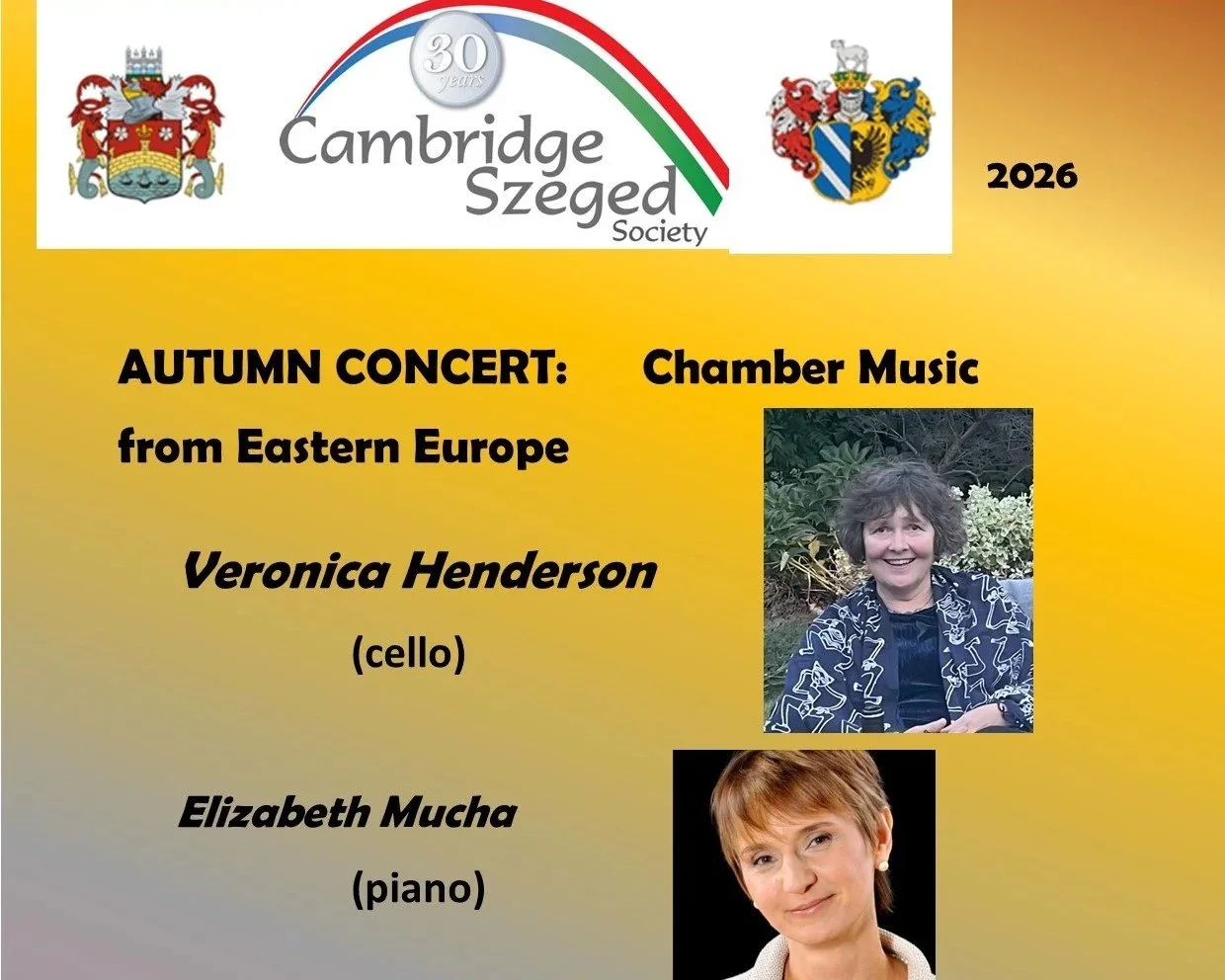
Veronica Henderson - cello Elizabeth Mucha - piano
Sarabande and Gigue in Old Style - Mátyás Seiber (1905 – 1960)
Three Miniatures - Erik Chisholm (1904 – 1965)
For Erika - Geraldine Mucha (1917 – 2012)
Romanian Dances - Béla Bartók (1881 – 1945)
Phantasy - Mátyás Seiber (1905 – 1960)
La Lugubre Gondola - Franz Liszt (1811 – 1886)
A Tale - Leoš Janáček (1854 – 1928)
Veronica Henderson and I are delighted to be performing a programme of music by composers of either East European origin or with links to Eastern Europe for the Cambridge Szeged Society. Hungary is represented by Franz Liszt, Mátyás Seiber, and Béla Bartók, and The Czech Republic by Leoš Janáček and Geraldine Mucha, who, though of Scottish/English birth, married Jiři Mucha (the painter Alphonse Mucha’s son) and spent most of her life in Prague. However, how did Scottish composer, Erik Chisholm, escape from our previous all Scottish programmes and find himself in an East European programme? He was a huge enthusiast and authority on the music of Janáček and in 1963, two years before he died, Pergamon Press commissioned him to write a book about Janáček’s opera. Also, his collection of songs based on Scottish traditional melodies, the Celtic Songbook, was published not in his native Scotland, but by the Ministry of Culture in the USSR.
Our programme opens with “Sarabande and Gigue in Old Style” by Mátyás Seiber. The sarabande, as a form, began as a fast Spanish dance in the 1500s, shaped by Arab influences, and it spread quickly through Spanish America. Seiber draws on the slower dance style, however, that it had evolved into by the Baroque era. The lively gigue simply derives from the folk jig.
Scottish composer, Erik Chisholm, found inspiration in the melodies of the Highlands of Scotland. In his ‘Three Miniatures’ the structure may be that of an elegant minuet, a lilting pastorale and a determined march – the musical language however clearly betrays his deep love of Celtic idioms.
“For Erika”, the short piece we will be performing by Geraldine Mucha has a very charming back story. Erika Neisner was the wife of the Austrian ambassador to Prague in the 1990s. The composer and Erika became good friends, as the Austrian Residence was in the next street to Geraldine’s home. Erika would frequently send Geraldine fresh sachertorte from Vienna, much to her delight! The piece was written as a gift in 2007.
We continue in Eastern Europe with Béla Bartók’s Romanian Dances. From 1906, for over a decade, he travelled throughout Eastern Europe, together with fellow Hungarian composer Zoltán Kodály, and these dances were inspired by tunes recorded on the newly invented Edison phonograph.
Seiber built on the research of Bartók and Kodály, but also developed his own eclectic style, with output showing the influences of Schoenberg, serialism and jazz, as well as writing film and lighter music. The Phantasy of 1944 perhaps reflects the grimness of the war years and leads us into the darker character of the next piece in our programme.
Liszt had stayed with Wagner in Venice in 1882, and a premonition of his host’s death inspired a first version of La Lugubre Gondola. That premonition was eerily fulfilled the following March. Wagner’s body was transported to the railway station by gondola.....
Liszt wrote another piano version in 1885, which was published in his own lifetime, and annotated a copy with versions for violin and for cello. The duo version was not actually published until 1974.
Our final work this evening brings together both the folktale and the fantasy themes of our programme. Janáček’s “A Tale” is thought to be inspired by an epic poem by V. A. Zhukovsky (1783-1852). While there may be a loose parallel with the narrative, it is generally thought to be a free fantasy of fairytale-like archetypes rather than an actual study of the personalities in “A Tale about Tsar Berendyey.....”. It points to Slavonic sounds evoking a magical dream world. This version is in three movements.