Krassimira Jeliazkova - violin
Elizabeth Mucha - piano
Louis Spohr (1784 – 1859) Potpourri on Themes from Mozart’s “The Magic Flute”, Op 50
Erich Wolfgang Korngold (1897 – 1957) Four pieces from the incidental music to Shakespeare’s “Much Ado About Nothing”, Op. 11
Maiden in the Bridal Chamber
Dogberry and Verges
Garden Scene
Masquerade
Igor Stravinsky (1882 - 1971) Pas de Deux from the ballet, “The Fairy’s Kiss”
a) adagio b) variation c) coda
Darius Milhaud (1892-1974) Cinéma-Fantaisie after ‘Le Bœuf sur le Toit’, Op 58
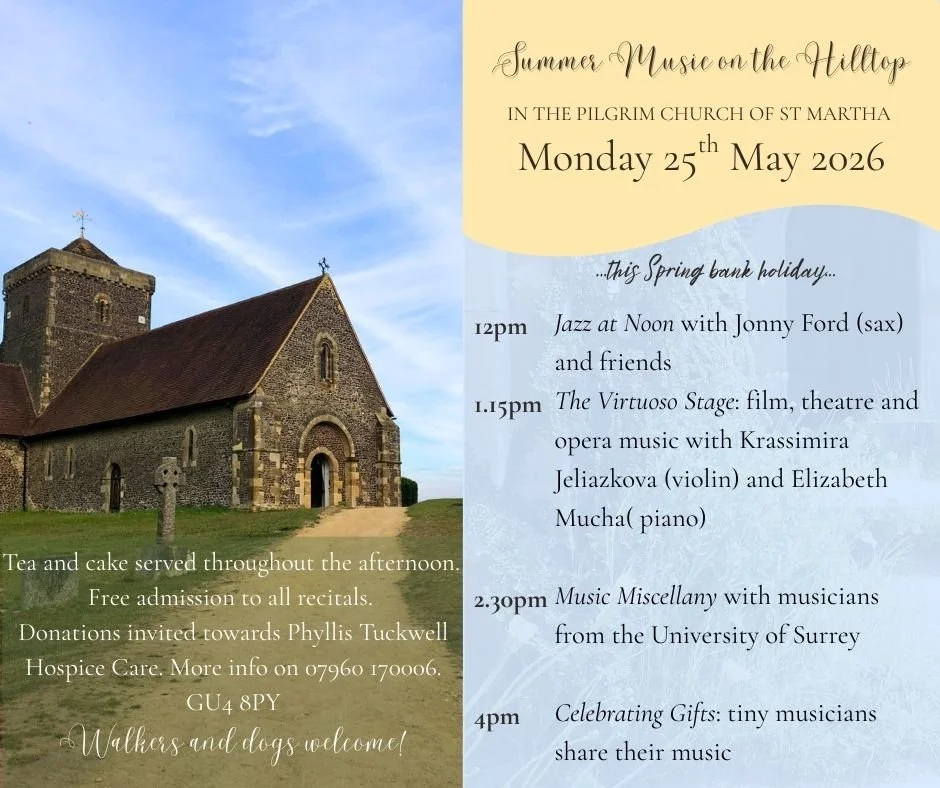
Delighted to be playing our programme “The Virtuoso Stage” in the dramatic setting of St Martha’s-on-the-Hill (just outside Guildford) on the second May Bank Holiday of 2026. Perched on the top of a hill on the North Downs Way National Trail, the church featured briefly in the 1944 film “A Canterbury Tale”. Our programme “The Virtuoso Stage” showcases pieces inspired or intrinsically linked to opera, theatre, dance, or film. Moreover, they were all hits in some form or another!
A highly influential figure in German music, Louis Spohr (1784-1859) was a much sought-after violinist, conductor and composer. He composed the Potpourri on themes from Mozart’s “Die Zauberflöte” (The Magic Flute) in 1811, a mere 20 years after the opera’s very successful premiere in 1791 - also the year Mozart died. Originally this was the second movement of a sonata concertante for himself and his wife, Dorette Scheidler, considered to be one of the most important harpists of the early 19th century. This movement proved hugely popular, and in 1820 Spohr transcribed it for violin and piano. Using only themes from the 2nd Act, the composition includes Pamina’s well known aria, “Ach, ich fühl’s”, Papageno’s “Ein Mädchen oder Weibchen”, and Monostatos’ aria, “Alles fühlt der Liebe Freuden”. Also included is the charming music sung by the three spirits and the more serious fugal accompaniment to the Lutheran chorale sung by the two armoured men who promise enlightenment. Spohr’s version for piano and violin has lost little of the charming original character of the harp.
In 1918, the 21-year-old Austrian composer Eric Wolfgang Korngold (named after Mozart) was commissioned to compose the incidental music for a German language production of Shakespeare's play, “Much Ado About Nothing”. Originally composed for chamber orchestra, the work consisted of 18 separate sections, some as short as 30 seconds serving as scene transitions to more substantial sections of five to six minutes. Due to the postponement of the production, Korngold fashioned an orchestral suite out of the musical material he had already composed. This was first performed three months before the curtain lifted on the actual production to great acclaim and subsequently led to sold out performances of the theatre play. When the run was extended but no orchestra was available, he created a version for violin and piano for the theatre and later a concert version. By 1933, Korngold’s orchestral suite “Much ado about nothing” was in the repertoire of over 100 orchestras worldwide. With the rise of the Nazis, Korngold’s music, like the music of many Jewish composers, was banned and disappeared from European stages for several years. Korngold left Europe in the mid-1930s and settled in Hollywood where he became one of the leading composers of film music. It is only in recent years that his music is being heard more often in on concert stages.
The Russian composer, Igor Stravinsky, composed over a dozen ballet scores over the course of his long career. His most famous (or infamous) was “The Rite of Spring” commissioned by the Russian Impresario Diaghilev for his company, the Ballet Russes: it caused a sensation in 1913 at the Paris premiere. In 1928, for the 35th anniversary of Tchaikovsky's death, Stravinsky was asked to compose a ballet inspired by Tchaikovsky's music and based on Hans Christian Andersen’s story, “The Ice Maiden”. Neither this ballet nor the original story was hugely successful unlike the other compositions in this programme, so how does it fit here? Embedded deep in the Pas de Deux movements which we are playing is possibly the best known of Tchaikovsky’s songs, “None but the lonely heart” known in its original German as “Nur wer die Sehnsucht kennt” by the celebrated German writer Johann Wolfgang von Goethe. This poem has been set to music by several composers including Beethoven (four times), Schubert (six times), Schumann, Wolf, and Tchaikovsky.
While Stravinsky adeptly concealed Tchaikovsky’s music, French composer Darius Milhaud openly assembled a collage of distinct Brazilian melodies, clearly audible, to create his highly acclaimed composition “Le Boeuf sur le Toit”. The two years (1917-1919), whilst serving as the cultural attaché at the French Embassy in Rio de Janeiro, and especially the music he heard there, made a great impression on the young Milhaud. After his return to Paris, he was asked to compose music to accompany a Charlie Chaplin silent movie. He turned to the melodic treasure trove he had encountered in Brazil to create “Le Boeuf sur le toit”. In his autobiography, first published in 1949, he wrote, “Still haunted by the memories of Brazil, I assembled a few popular melodies, tangos, maxixes, sambas, and even a Portuguese fado, and transcribed them with a rondo-like theme recurring between each successive pair”..
Nevertheless, this most Brazilian of ‘french’ compositions has proved to be one of Milhaud’s greatest successes. In 1920, the original orchestral version of “Le Boeuf sur le toit” received its premiere as the music for a ballet staged by the French poet, playwright, novelist, designer, film director, visual artist and critic, Jean Cocteau. The ballet also gave its name to a celebrated Parisian cabaret-bar, which opened in 1921 and became a meeting-place for Cocteau and his associates. Milhaud later arranged the work for violin and piano which he styled, “Cinema Fantaisie”. It was premiered in 1921 at the Salle Gaveau in Paris by French virtuoso violinist René Benedetti (to whom he dedicated this version) with pianist Jean Wiener. Milhaud never saw his music paired with a Chaplin film during his lifetime, however in more recent years a performance by violinist Gidon Kremer was added to Chaplin’s 1916 film, “The Count”. This collaboration, available on Youtube, demonstrates the compatibility of Milhaud’s music with Chaplin’s cinematic genius.